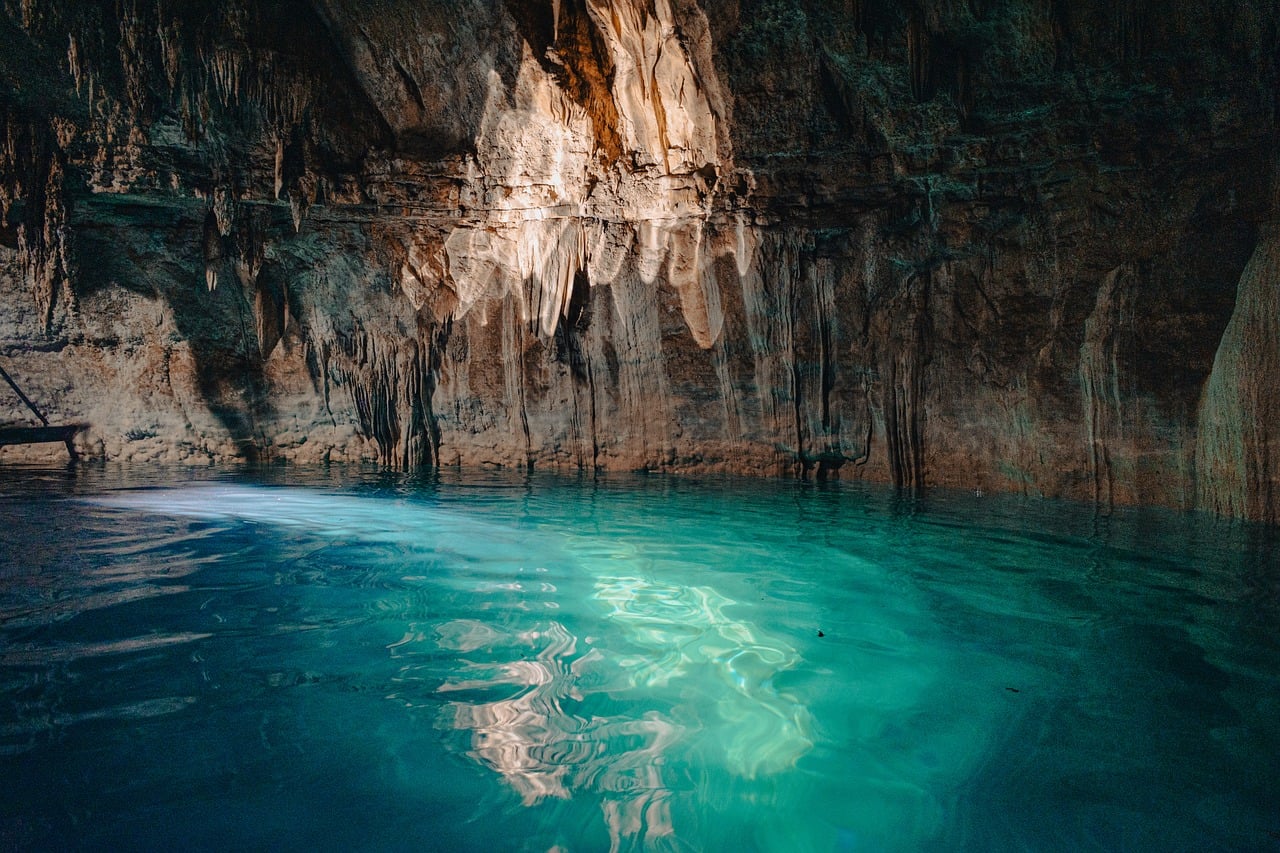
Which cenotes are closest to Tulum?
The cenotes are close, genuinely close. From the beach, the nearest one is about 15 minutes by car and the farthest on this list about 25. Nearly all of them sit on two roads: the Cobá road heading inland out of town, and Highway 307 running north toward Playa del Carmen.
That's all the geography you need. Once those two lines make sense, planning the day is easy.
Cenote Calavera: the closest and the most playful
Calavera is the first one you hit leaving town on the Cobá road, only a few kilometres out. It's three holes in the rock, two small and one large, that look like a skull from above. Hence the name.
It's small, with no beach and no gentle steps. You climb down a ladder or you jump. That makes it the favourite for people who want to throw themselves in the water and the wrong pick for anyone who wants to float and read. Short on time, or want a swim before lunch? This is the one.
Gran Cenote: the postcard
Gran Cenote is also on the Cobá road and it's the best known of them all. Very clear water, rock formations, turtles swimming between people's legs. It's beautiful and everybody knows it, so by mid-morning there's a queue.
It opens around 8 a.m. Arrive then and the water is close to empty, and you're leaving right as the vans start unloading. Arrive at 1 p.m. and you'll be sharing it with a crowd. No trick to it, just timing.
Zacil-Ha: for a slow swim
Zacil-Ha sits on that same Cobá road, a few minutes further along. It's open, shallow in much of it, with edges where you can sit. Everything moves slowly here, and people stay for hours.
It's the one we recommend when someone tells us they want a cenote but not an excursion. You arrive, you swim, you dry off in the sun, you go back. That's it.
Dos Ojos: caves, snorkelling and diving
Dos Ojos is north, out of Tulum on the 307. Two connected caverns, and it's the system people look for when they want to snorkel inside caves or dive with a guide. It's the priciest on this list and the one that asks for the most time: count on half a day for the full route.
If you just want an hour in the water, don't drive out here. Calavera or Zacil-Ha give you the same thing with less road.
What it costs and what to bring
Entry to the cenotes around here runs roughly 150 to 500 pesos per person depending on which one, and it's better to pay in pesos because several don't take cards or give a poor rate on dollars.
Bring this:
- Cash in pesos, for entry, parking and the person watching the cars.
- Biodegradable sunscreen, or better, none at all. Most cenotes ask you to shower before going in and won't allow regular sunscreen, because the water is fresh and feeds straight into the underground river system.
- Your own towel. The smaller cenotes don't always rent them.
- Shoes that can get wet. The rock is sharp.
What time to go
Early. Between 8 and 10 a.m. the cenotes open, the water is still, the light comes in straight and the organised groups haven't arrived. After midday it flips.
Mornings are slow here, and that slowness is best spent in the water. Have breakfast with us, head out at 8:30, come back for lunch. The rest of the afternoon stays free for the beach.
Getting there from the beach
By car or taxi it's straightforward: leave the beach road, cross town, take the Cobá road. You can bike to Calavera and Gran Cenote too, though it's a stretch of highway with traffic and sun, so go early or skip it in the hottest hours.
If you'd rather not drive, at The Nest we can arrange private transport and cenote tours for you. Tell us the day before and we'll have it ready.
The advice we always give
Don't do four cenotes in one day. It's the classic trap. You end up tired, hungry and you haven't actually enjoyed any of them. Pick one, stay two or three hours, eat well, leave the afternoon for the sea. Take your time. The cenotes will still be here tomorrow.